Loading...
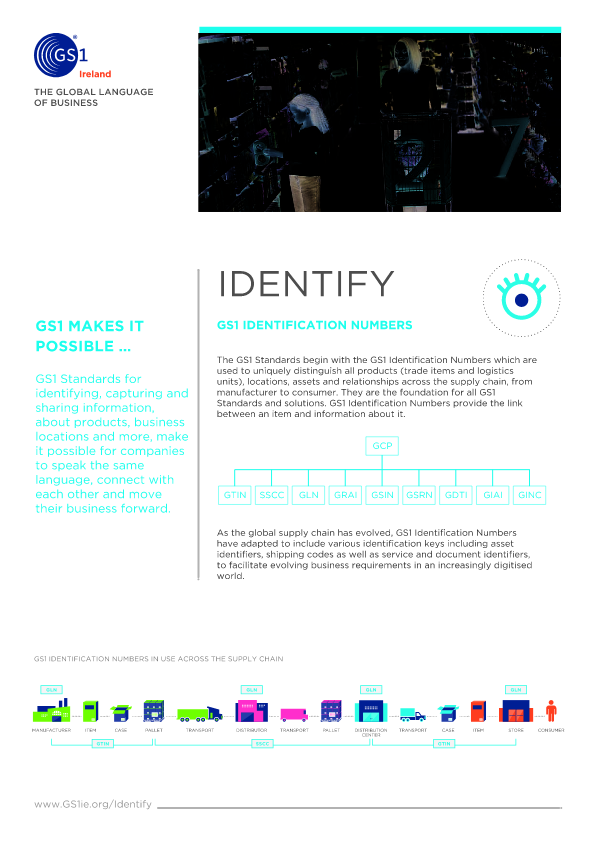
 GS1 standards begin with GS1 Identification Numbers, used to uniquely distinguish all products, logistics units, locations, assets and relationships across the supply chain from manufacturer to consumer. GS1 Identification Numbers provide the link between an item and information about it.
GS1 Identification Numbers have been used to distinguish products, locations and more for the past fifty years. They are the foundation for all GS1 standards. As the global supply chain has evolved, GS1 Identification Numbers have extended to include assets, documents and more to keep pace with business developments.
Read on to learn about all of the different Identification Numbers you can create using your unique GS1 Global Company Prefix (GCP).
Download the introductory leaflet: GS1 Identify
GS1 Identification Numbers
The GS1 Identification Keys give companies an efficient way to access information about items in their supply chains, and share this information with trading partners. ID Keys enable organisations to assign standard identifiers to products, documents, physical locations and more.
Because GS1 ID keys are globally unique, they can be shared between organisations, increasing supply chain visibility for trading partners.
To build a GS1 ID key, your organisation must become a member of GS1 and obtain a GS1 company prefix (GCP). This will form the basis of your ID keys. There are 11 GS1 ID keys, allowing organisations to connect physical events and related information, as in the table below.
The following GS1 Identifiers are most commonly used in retail and supply chain applications:
Global Trade Item Number (GTIN) can be used by a company to uniquely identify all of its trade items. GS1 defines trade items as products or services that are priced, ordered or invoiced at any point in the supply chain.
An SSCC or Serial Shipping Container Code is used to identify items assembled for the purpose of transport or storage. SSCCs are typically used to identify outer cases, pallets or entire shipments.
The GLN or Global Location Number supports the identification of physical locations, legal entities and functional locations.
In addition to the above, the GS1 Identifiers below may be used by any company that adopts the GS1 System for more advanced applications:
GIAIs or Global Individual Asset Identifiers are used to uniquely identify a specific asset.
The Global Returnable Asset Identifier is suitable for the management of reusable transport items, transport equipment, and tools and can identify these returnable assets by type and if needed also individually for tracking and sorting purposes.
The Global Service Relation Number can be used by services organisations to identify their relationships with individual service providers (such as doctors who work for a hospital) and individual service clients (such as the metering points of an electricity company, or the loyalty account members of a retailer).
The Global Document Type Identifier can be used by companies to identify documents, including the class or type of each document.
The Global Identification Number for Consignment can be used by companies to identify a consignment comprised of one or more logistic units that are intended to be transported together.
The Global Shipment Identification Number (GSIN) is a number assigned by a seller and shipper of goods to identify a shipment comprised of one or more logistic units that are intended to be delivered together.
The Component/Part Identifier enables companies to identify components and parts, typically where an Original Equipment Manufacturer (OEM) defines the specifications of a component or part that is part of its final product (such as an automobile).
The Global Coupon Number enables companies to identify digital coupons – a ticket, document or electronic presentation that can be exchanged for a financial discount or for loyalty points when making a purchase.
The Global Model Number enables users to uniquely identify the product model through the entire life cycle of the product: design - production – procurement – use – maintenance - disposal.
If you need to Identify a Book or Periodical (magazine, newspaper, journal, etc.) you will need an ISBN or an ISSN, which GS1 Ireland does not issue. You can find more information about ISBN and ISSN in our article: