
- Home
- Industries
- Construction
- Use Case: Digital Continuity: Building the Golden Thread of Asset Information from Day One
Loading...
Digital Continuity: Building the Golden Thread of Asset Information from Day One
Why adopting GS1 standards early is essential to protecting clinical capacity, managing lifecycle costs and delivering safer, more sustainable healthcare facilities.
Modern hospitals are complex to design, build, commission and operate. Clinical effectiveness and speed to react to unplanned down time of critical building systems depends on both sound infrastructure and accurate, accessible information about the thousands of assets that support safe, reliable operation of healthcare facilities.
The GS1 Ireland recently authored article in the acclaimed Engineers Ireland Journal titled Digital Continuity: Protecting clinical capacity through better asset information, highlights why this end-to-end information flow (sometimes knows and the “Golden Thread”) must be established well before construction begins.
Begin with the Owner's Information Needs — Not the Asset Tag
GS1 Ireland advocates early collaboration among healthcare owner-operators, designers, information managers, procurement teams and facilities management specialists to agree the information needed throughout a building's operational life commencing with design decisions, construction commissioning and the increased use of Soft Landings.
This requires coordinated development of the Organisational Information Requirements (OIR), Project Information Requirements (PIR), Asset Information Requirements (AIR) and requirements for the Asset Information Model (AIM), in line with ISO 19650 BIMprinciples.
A key outcome from the AIM should be an agreed register of Core Maintainable Assets (CMAs): building systems, components and equipment whose performance, maintenance, replacement or failure could materially affect clinical capacity, patient safety, statutory compliance, energy use or operating costs.
The initial CMA register should be prepared during project definition and design. Its scope, information requirements and delivery responsibilities should then be confirmed with the appointed contractor through the BIM Execution Plan (BEP) and related information delivery arrangements.
This embeds asset identification and traceability in the project from the outset, rather than adding them at handover or end of the 18-to-24-month Soft-landing’s effort post practical completion.
One Persistent Identity for Each Asset — Throughout Its Life
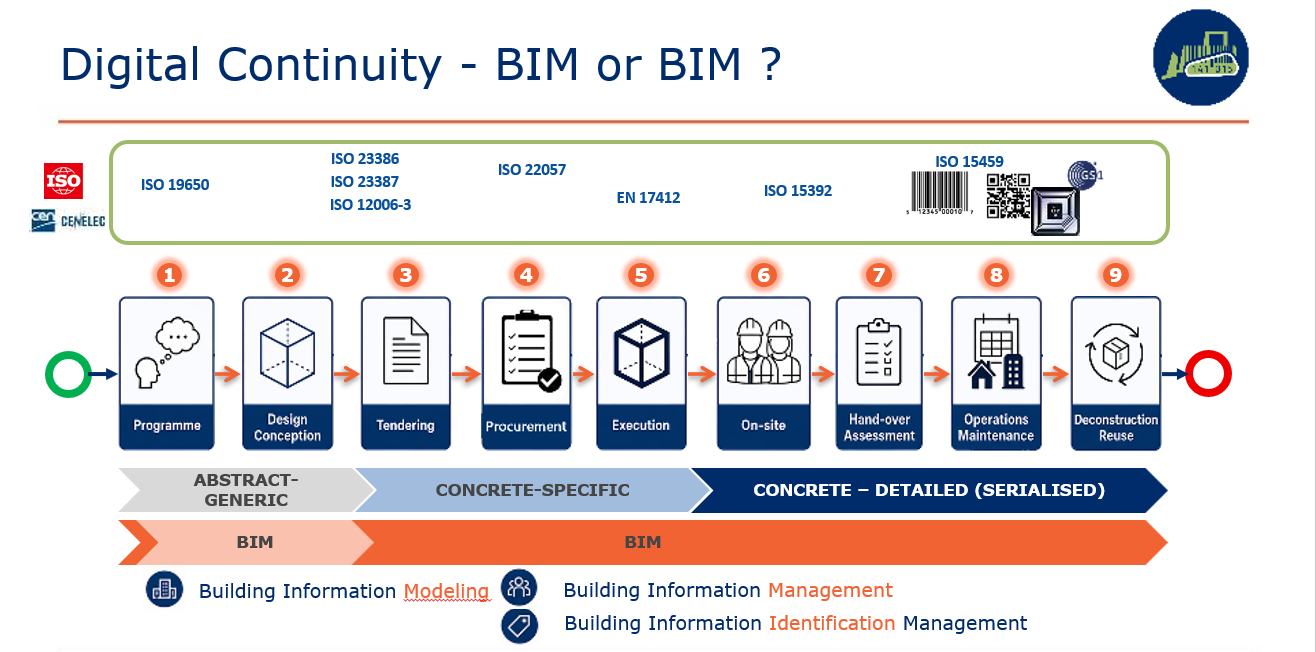
Each CMA can receive a persistent Global Individual Asset Identifier (GIAI), linked to the manufacturer's Global Trade Item Number (GTIN) or, preferably where item-level product serialisation is available for “Made to Order” purchases a Serialised Global Trade Item Number (S-GTIN).
The CMA is also linked to a Global Location Number (GLN) that identifies its building, floor, room or operational location within an agreed spatial hierarchy which is critical in facilitating faster response times to Reactive Work Orders issued to FM or Specialist equipment technicians who have to get from the car park to the correct room in the least amount of time via wayfinding supported by GLNs and on arrival has immediate access to the required product service history logs, O&M manuals, RAMS, and latest aftercare best practices provided by the manufacture based on the GTINs or S-GTINS being mapped to the GIAIs plus validated replacement parts to had at the workface. .
Together, these globally interoperable identifiers keep information connected across BIM, procurement, construction, commissioning and facilities management systems right up to decades later, effective Carbon cognisant decommissioning. This workflow covers the What the asset is, Where it is, Why it was selected, When it was installed and commissioned, and How its condition and operational status change. If GDPR allows the Who installed it can be recorded too that who can be at individual or company/dept level.
GS1 Digital Link can give the physical asset a direct, standards-based connection to its digital information, independent of any single software vendor.
Beyond Handover: A Living “Digital Building Logbook” (DBL)
The goal is to make every human interaction that changes a Core Maintainable Asset's state or status recordable as a structured, time-stamped lifecycle event.
Events include installation, commissioning, inspection, preventive and corrective maintenance, component replacement, refurbishment, decommissioning, and eventual reuse or recycling.
GS1 EPCIS 2.0 offers a standards-based way to record and exchange these events across organisations and software systems, provided the necessary integrations are implemented.
These records can support a continuously updated Digital Building Logbook (DBL), retaining each asset's identity, compliance evidence and operational history over decades.
This approach aligns with the information continuity and lifecycle data ambitions explored by the EU-funded Horizon Europe openDBL project. Its published outcomes offer a useful reference for developing interoperable building logbooks.
For healthcare owner-operators, this offers better-informed maintenance decisions, stronger auditability, less information loss when systems change, and more reliable evidence to help protect clinical capacity.
The central message is clear: begin the Golden Thread of asset information with the owner's requirements, not at construction handover.
Early engagement with GS1, identification of Core Maintainable Assets before procurement and use of persistent identifiers throughout project information management lay the foundations for genuine cradle-to-cradle Digital Continuity in healthcare.
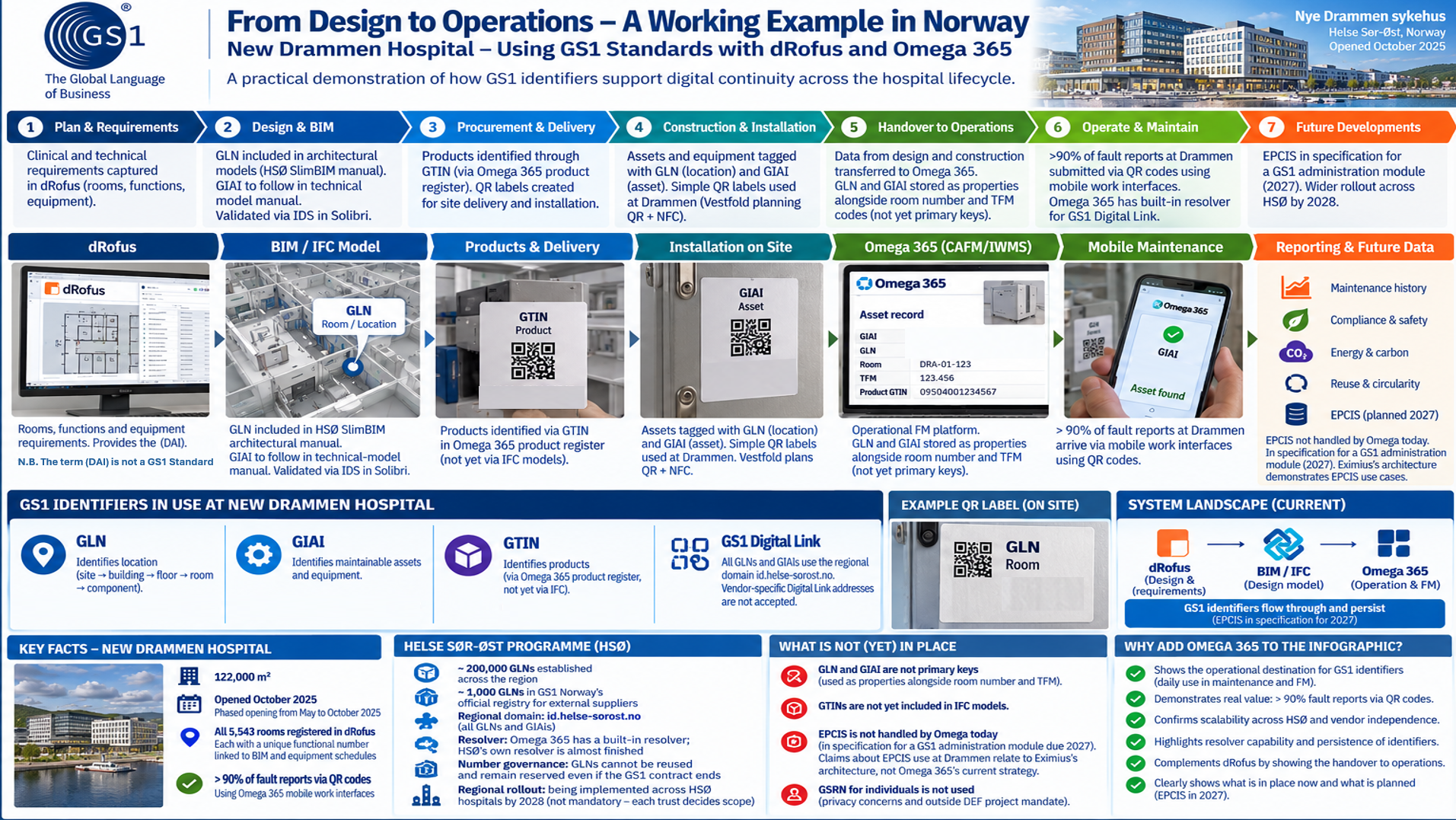 Footnote: Why the Infographic References Omega 365 and dRofus
dRofus supports planning and structured room and equipment information. BIM and “buildingSMART International (bSI) IFC, bSDD & IDS standards provide a route for information exchange and validation. All four Norwegian regional health authorities have signed an agreement with Omega 365. The intended future approach is for every hospital to use GLN and GIAI tags; this should not be read as confirmation that implementation is already complete across all four regions. Whether all hospitals will also use QR codes remains unconfirmed, although there is a strong possibility that the other regions will follow the HSØ regional setup. For HSØ, implementation has been stated as due within three years, by the end of 2028 at the latest. No equivalent deadline has been confirmed for the other three regional health authorities.
Please read the article in full:Digital Continuity: Protecting clinical capacity through better asset information — Engineers Ireland Journal