- Home
- Industries
- Construction
Loading...
By leveraging globally unique identification and data exchange standards, GS1 can bring visibility, traceability and certainty to building and asset information for the architecture, engineering, construction (AEC) and facilities management industries.
GS1 identifiers create a globally unique identity for products, assets, people, locations, and service relationships. Right from the early stages of a building’s design, architects and engineers can identify the products and parts that meet their specifications, including their environmental and operational cost attributes, and track their delivery on site.
During installation and commissioning on-going verifications can occur, validating that the materials and assets installed meet the requirements specified in the Risk Assessment Method Statements and in the Health and Safety file. Maintenance and facilities management teams also benefit greatly from the implementation of GS1 standards with digital links created between personnel, their qualifications, job tickets and schedules.
GS1 Identifiers for AEC Sector
Explore the key GS1 identifiers used in the Architecture, Engineering, Construction and Facilities Management sectors for product, location and asset identification.

GTIN
The GTIN or Global Trade Item Number is used to uniquely identify a product or traded item.

GLN
The GLN or Global Location Number is used to uniquely identify a legal entity (company) or physical location.

SSCC
SSCC or Serial Shipping Container Code are typically used to identify outer cases, pallets or entire shipments.

GIAI
GIAIs or Global Individual Asset Identifiers are used to uniquely identify a specific asset.

GRAI
GRAIs or Global Returnable Asset Identifiers are used to uniquely identify a returnable asset.

GSRN
GSRNs or Global Service Relationship Numbers are used to identify and record an instance of a service being provided to a recipient.
New challenges in the construction sector
Stakeholders across the entire construction value chain are facing a series of upcoming challenges driven by local and EU regulations, circularity and sustainability requirements, all aimed at fostering a greener and more environmentally-friendly future.
To effectively address these challenges, the construction industry must elevate its efficiency levels and streamline its supply chains and life cycle processes. The initial crucial step involves digitising these activities and processes, thereby establishing interoperability and the necessary level of transparency mandated by regulations.
By embracing open global standards, stakeholders in the construction value chain can play a pivotal role in cultivating a more connected, efficient, and productive industry. This transformation will yield benefits for all parties involved in the planning, design, construction and maintenance of buildings and infrastructure projects.
How can GS1 standards help?
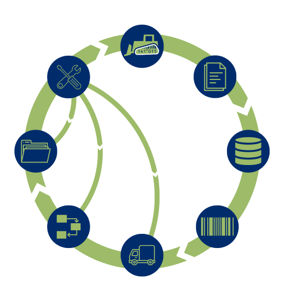 The GS1 system of standards is designed to enhance the efficiency of business processes and deliver cost savings through automation based on globally unique identification and digital information.
Businesses and regulatory bodies worldwide are increasingly collaborating to promote more sustainable economic, environmental and social practices. The circular economy model, which emphasises activities like sharing, leasing, reusing, repairing, refurbishing and recycling existing materials and products, stands as a pivotal aspect of sustainability.
The GS1 system’s three core components - Identification, Data Capture and Data Share - empower our members to establish globally unique means to identify real-world entities. This allows them to serve as the subject of electronic information that can be stored and/or transmitted by end users, effectively bridging the gap between the physical realm and the realm of electronic information.